
Reading your shot group on a laser range
By Asset Firearms instructors. 14 November 2026.
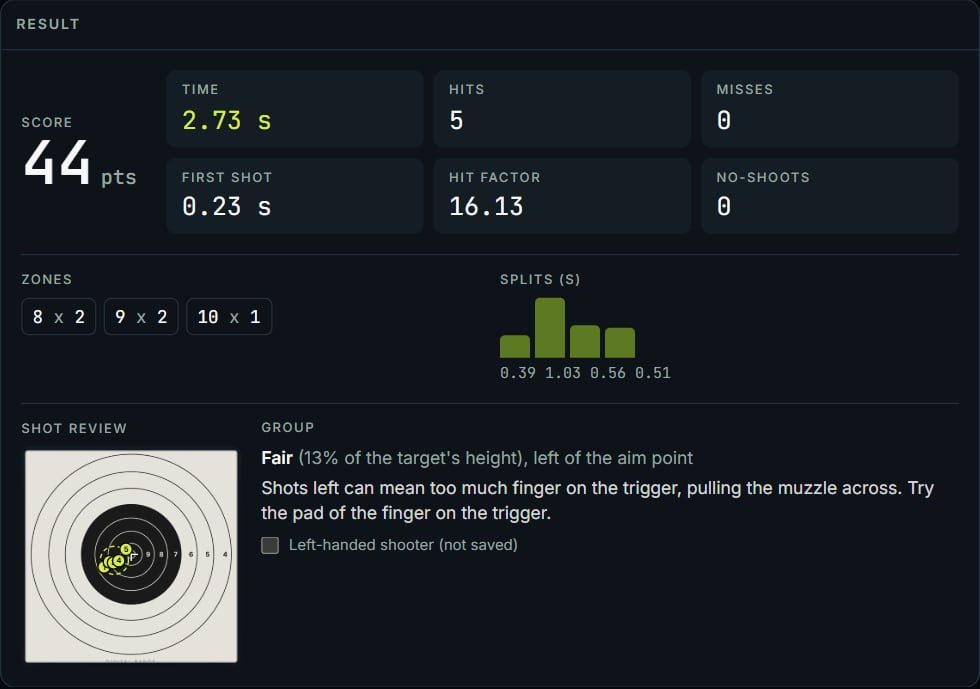
A shot group is a record of what your hands, eyes and trigger finger did at the moment each shot broke. One wide shot tells you very little. Five shots that sit together, away from the centre, are worth reading.
This is how I talk a member through a group. None of it is a diagnosis. A group points you towards things to check, and the checking is best done with a coach watching you shoot.
Shoot a group worth reading
Before you read anything into a group, make it a fair sample.
- Fire at least five shots on the same aiming point, at a pace you can control.
- Use the same grip, stance and sight picture for every shot.
- Pick a distance where you can hold the sights steady. Further away only magnifies the noise.
- Call each shot as it breaks: say where you think the sights were. Compare that with where it landed.
In Digital Range the Five-Shot Group drill does exactly this: five rounds on a precision bullseye, with a review of where every shot went when the run ends. On paper or on the projected range, you see the pattern straight away instead of walking down to a target. The drill library has the full list of accuracy drills.
First, decide what kind of group it is
There are two different problems, and they need different fixes.
- A tight group in the wrong place. The shots agree with each other but not with your aiming point. Look at sight alignment, your aiming point, and whether the laser trainer itself needs adjusting to match the sights.
- A scattered group. The shots disagree with each other. That points to something changing from shot to shot: grip pressure, trigger press, sight focus or breathing.
Fix the scatter first. There is no point moving a group that is not a group yet.
Groups that sit low
Low shots are the pattern I see most with newer shooters. Things to check:
- Pushing forward before the shot. Some shooters drive the muzzle down just before the break, often from anticipating the shot. A laser trainer has no recoil, so if the habit still shows, it is worth working on now.
- Front sight drifting. If the front sight sits low in the notch at the break, the shot follows it.
- Tension in the wrist. Ask your coach to watch the muzzle in the half second before the shot.
Groups that sit high
High groups are less common. Check these:
- Front sight sitting too high in the rear notch.
- Lifting the head or eyes to look for the hit before the shot has broken. Keep watching the sights through the press.
- Heeling, where the base of the palm pushes the bottom of the grip forward.
Groups that drift left or right
For a right-handed shooter, the usual suspects are below. A left-handed shooter reads them in mirror image.
- Shots to the left: too much finger on the trigger, or the support hand squeezing harder at the break.
- Shots to the right: too little finger on the trigger, pushing the trigger sideways instead of straight back.
- Shots spread side to side in a line: grip pressure changing between shots, or the trigger press speeding up and slowing down.
These are starting points, not rules. Two shooters with the same group can have different causes. That is why a second pair of eyes matters.
Using the laser to find the cause
Laser training shows you the trigger press without the noise and recoil of live fire. That makes it a good place to test an idea. A few ways I use it:
- Change one thing per group. Adjust finger placement, shoot five, read the group. Then try the next thing.
- Slow the press right down. If a slow, deliberate press closes the group, the problem is in the trigger, not the sights.
- Have your coach watch the muzzle, not the screen. The screen shows the result. The coach sees the movement that caused it.
The results panel gives you the zone and split for every shot, so you can see whether the bad shots were also the fast ones.
Write your own numbers down
Digital Range keeps no shooter data. There are no accounts and no history, and results stay on screen until the app closes. If you want to see whether your groups are tightening over a month, keep a notebook: the drill, the distance, how many shots landed in the centre ring, and a note on what you changed.
Take it back to live fire
A laser group shows you what happened at the break. It does not replace supervised live-fire practice, where recoil and noise add their own problems. Take what you learn on the laser back to the range, with an instructor, and check it holds up. If you are looking for supervised shooting, Asset Firearm and Crossbow Club runs it. For more on why the laser work carries over, read why laser dry fire builds real skill.