
The Bill Drill, El Presidente and the Mozambique explained
By Asset Firearms instructors. 14 November 2026.
Some drills last because they test something real in a few seconds. The Bill Drill, El Presidente and the Mozambique are three of them. Each one is short, easy to explain on the line, and hard to do well.
Here is what each drill asks of you, how it runs in Digital Range, and what to watch for when you coach it.
How all three start
All three drills start the same way. You stand ready, the instructor presses Space, and the start beep comes after a random delay of between 1.5 and 4 seconds. You cannot anticipate it, so you have to react to it. The timer runs from the beep, and the run ends when the last required hit lands.
All three use the metric silhouette target, scored by zone: the A zones in the centre of the body and the head score most, the zones around them score less, and the D zone at the edge scores least. Misses are recorded, never dropped. Each drill runs on the projected range or on printed paper targets.
The Bill Drill
Six rounds on a single target as fast as you can, on the beep.
- One metric target, centred, on an indoor range backdrop.
- Six hits end the run.
- Par time: 2.5 seconds.
- Shot from at least 7 metres.
The Bill Drill is about recoil control and trigger speed, and how far you can push one before the other falls apart. On a laser there is no recoil, so the drill becomes a test of how quickly you can press, reset and press again while keeping the sights on the A zone.
What to watch: the first split and the rest. A good run usually has a slower first shot from the draw or ready position, then even, quick splits after it. If the splits are fast but the hits spread into C and D, slow down until they come back into A. Speed you cannot hit with is not useful.
El Presidente
Three targets, two rounds each, reload, two rounds each. Twelve rounds total.
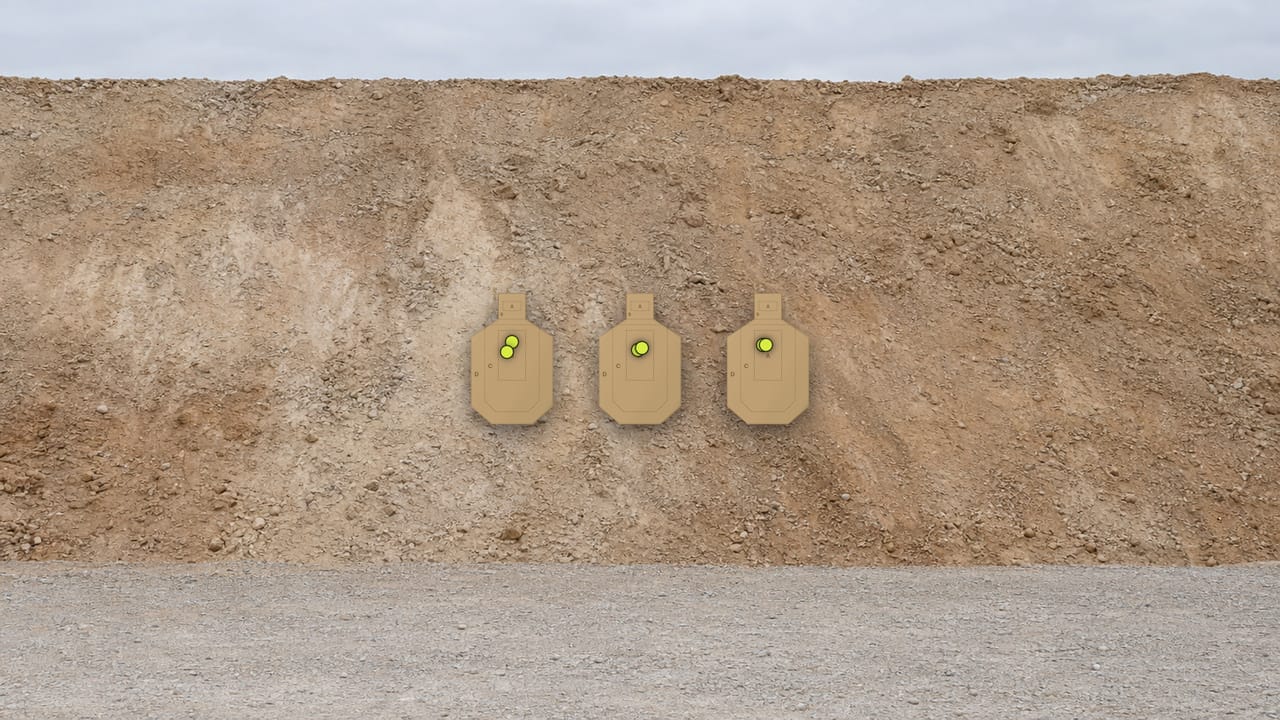
- Three metric targets side by side on an outdoor bay backdrop.
- Twelve hits end the run.
- Par time: 10 seconds.
- Shot from at least 10 metres.
El Presidente brings in transitions and a reload. You put two on each target left to right or right to left, reload, then two on each again. In Digital Range the run ends at twelve hits, so the reload sits inside your time.
What to watch: the gaps. The splits on the results screen show you where time went. A long gap between targets means the eyes are arriving late; drive them to the next target before the muzzle. A long gap in the middle is the reload. Those two places are where most shooters find their time.
Check your club's rules before you run any drill that involves a reload with a laser trainer and magazines. Your range standing orders decide how that is handled.
The Mozambique
Two rounds to the body, one to the head, on the beep.
- One metric target, centred, on a shoot house backdrop.
- Three hits end the run.
- Par time: 2 seconds.
- Shot from at least 7 metres.
The Mozambique, also called the Failure Drill, trains a change of pace inside one string. The two body shots can be quick. The head shot needs a smaller, more careful sight picture. The drill shows whether you can make that change without losing time or accuracy.
What to watch: the third shot. Read where it landed and its split. If it is fast and in the body, you never changed your sight picture. If it is in the head but the split is long, practise settling the sights sooner. On the results screen the zone of each hit tells you which.
Getting the most from them
- Start slower than the par. Par times are a target, not a starting point. Clean hits first.
- Run each drill several times in a row. One run is luck. Five runs show you a pattern.
- Use the session board. Finished runs are ranked for the current drill, which works well for a group of members taking turns.
- Write your numbers down. Digital Range keeps no shooter data, so if you want to compare this month with last month, note your times and zones yourself.
All three drills are in the Digital Range drill library, along with the Reload Drill and Three Target Transitions if you want to work on one piece at a time. For more on reading the timer, see par times, splits and first-shot time.
Laser drills sharpen the mechanics. They supplement supervised live-fire practice and never replace it, so take what you learn back to the range with an instructor.